
Light Up Navajo
Bringing Electricity to Families in the Navajo Nation
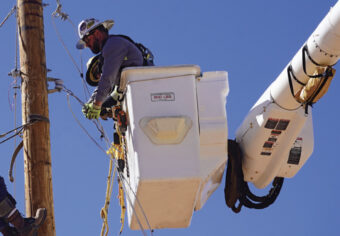
Mohave Electric Cooperative (MEC) first learned about the Light Up Navajo project through our Arizona statewide cooperative, Grand Canyon State Electric Cooperative Association, which represents all electric cooperatives across Arizona. Recognizing the importance of this volunteer initiative, MEC decided this was a cause worth supporting by donating time and resources.
Light Up Navajo began as a project in 2019 led by the Navajo Tribal Utility Authority (NTUA) and the American Public Power Association (APPA) to bring electricity to the families living in the Navajo Nation who still live without electricity, running water, heating, air conditioning, refrigerators, microwaves or only have temporary power through NTUA leased solar or personal generators.
The Navajo Nation is the largest American Indian nation within the United States, spanning portions of northeastern Arizona, northwestern New Mexico, and southeastern Utah. For context, the Navajo Nation serves more than 27,000 square miles of land – larger than the entire state of West Virginia, and MEC’s service territory covers 1,287 square miles.
To date, there are an estimated 10,400 Navajo families remaining without access to reliable power. In recent years, the project has grown to include 45 volunteer utilities from 16 different states, including 17 rural cooperative utilities, 2 of them from Arizona. Over the past 4f years, the project has connected nearly 900 homes to electricity for the first time.
Jerry Hardy, MEC’s Engineering and Operations Manager, brought the volunteer opportunity to MEC’s CEO, Tyler Carlson, and senior management. Mr. Tyler Carlson expressed strong support for the initiative, stating, “We fully support this cause, and we are proud to support our linemen who volunteer their time and skills to help bring power to families who have lived without it for too long.”
Apprentice Lineman Cole Garcia volunteered for the project and on Saturday, July 5, 2025, traveled the 6-hour and 45-minute drive to Window Rock, AZ for orientation with the other volunteers across the country. Afterwards, they were stationed outside Tuba City, AZ, for the week, approximately 300 miles away from MEC headquarters in Bullhead City, AZ.
Chad and Cole were paired with lineman volunteers from a Connecticut municipal utility – Norwich Public Utilities – and NTUA electric line crews. NTUA loaned a bucket truck for the volunteers. Chad, Cole, and team rotated jobs throughout the week, each essentially being a jack-of-all-trades. “1 day I was running the digger derrick truck, another day operating a wire trailer, another time performing groundman duties, and being the point in the bucket lift,” Chad Valenzuela, MEC Journeyman Lineman, reflected. Chad has worked at MEC for 7 years and is based out of our Bullhead City office. He first started as a groundman and received multiple promotions after completing MEC’s Union Apprenticeship program.
“This was a different experience,” Chad said. “I mostly work with hot or live wires when performing troubleshooting or responding to outages and new service requests. Out here, we were building entirely new lines across far distances that were not energized.”
Together, the team installed 30 wooden poles – ranging from 30 – 40 feet in height and 2 miles of single-phase power over the duration of the trip.
“The majority of MEC’s eastern service territory is remote, so building a line outside Tuba City felt similar to building a new line in the Peach Springs area of our territory,” said Cole Garcia, MEC Apprentice Lineman.
“Working on this project was a great career experience,” Cole reflected. “It was valuable to see how other utilities would build out a line.” Cole has been with MEC for 3 years. He was hired as a groundman days after his graduation from lineman school in Northern California, and within 2 months was promoted to Apprentice Lineman.
Mohave Electric Cooperative was formed in July 1946 as a not-for-profit utility because the surrounding investor-owned utilities would not bring power to our area. Similarly, the Navajo Nation also did not have access to electricity as investor-owned utilities would not build a distribution line to or on reservation land. NTUA was created in 1959 by tribal leaders to provide basic utility services to Navajo communities. During their week-long journey, Chad and Cole helped build out a line to 4 families and were able to connect 2 families to electricity for the first time.
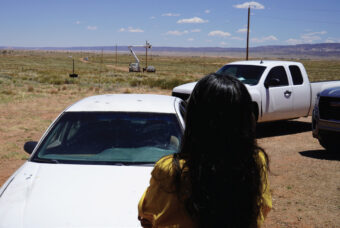
Navajo resident, Esther Whiterock, shared with MEC, “I’ve been here 62 years and have never lived with electricity.” MEC captured a photo of her standing outside her ancestral home, watching the crews build the line closer and closer to her house. “The first thing I’m looking forward to getting is a refrigerator, so I can have fresh meat and vegetables.” Esther mostly buys canned food from the grocery store 32 miles from her house. The only way to preserve fresh food is through ice chests and dry ice or running generators, but the gas station to buy fuel is 27 miles away and can be expensive in price. “My mother spoke about the idea of having electricity, but didn’t live to see it, and this week it’s becoming a reality,” Esther added.
Cole reflected, “Seeing the family have power for the first time – it was amazing to see their reactions.”
To end the week of hard work, NTUA, APPA, and the Navajo community hosted a celebratory appreciation dinner for all the volunteers. The gathering was a time to rejoice and memorialize this year’s accomplishments.
“It was great to come together with everyone and share this moment with them,” Chad recalled.
When asked if they would volunteer again, both linemen responded with enthusiasm, “YES!” Chad added, “It’s a very humbling experience. 1 I highly recommend to others, and 1 you will not forget.”